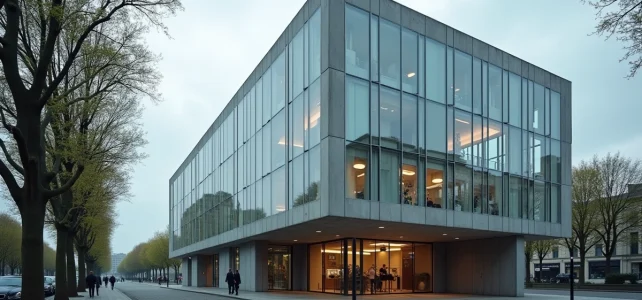
Rennes is home to several tens of thousands of active businesses within its territory. Among them, national and international groups have chosen to establish their headquarters there, anchoring the Breton capital in an economic dynamic that far exceeds its regional basin. The productive fabric of Rennes is not limited to the digital startups often highlighted: it relies on players in large retail, business services, fitness, and real estate development.
Headquarters in Rennes: a concentration that impacts the Breton economy
Rennes hosts decision-making centers whose influence is national, even international, although the city is less often mentioned than Paris, Lyon, or Bordeaux in this regard. The Samsic group, specialized in business services (cleaning, security, temporary staffing), has built a network from Rennes that extends well beyond Brittany.
This presence of headquarters generates a direct ripple effect on the local economy: skilled jobs in support functions, reliance on local service providers, and attractiveness for other companies looking to establish themselves in the Rennes urban area. A detailed overview of the corporate headquarters in Rennes allows for measuring the sectoral diversity of these players.
The phenomenon is not limited to big names. Real estate developers like Greestone Immobilier, based on Boulevard Volney, contribute to the urban transformation of the city while maintaining their governance on-site. This type of player, less visible than consumer brands, directly participates in the production of housing and the attractiveness of the territory.

L’Orange bleue in Rennes: a case of locally anchored hyper-growth
The group L’Orange bleue mon coach Fitness illustrates a little-documented phenomenon: that of a national brand that maintains its headquarters in Rennes despite rapid expansion. Thirty years after its founding in the city, the group inaugurated a new headquarters of 3,700 m² with an investment of €15 million in 2024.
With a reported turnover of €190 million, L’Orange bleue plans to open about fifty more locations by the end of 2026. This choice to remain in Rennes, rather than migrating to Paris or another metropolis, reflects a territorial attachment that is not insignificant. The cost of professional real estate in Rennes, significantly lower than that of the capital, likely plays a role in this decision.
This case raises a broader question: Can Rennes retain its growing companies in the long term, or do the largest eventually relocate their strategic functions to better-connected metropolises?
Rennes’ productive fabric: beyond large groups
According to aggregated data from the Sirene directory, Rennes has approximately 47,600 active businesses. This figure reveals a dense economic network, predominantly supported by very small and small enterprises. The headquarters of large groups capture media attention, but they represent only a fraction of the city’s productive activity.
Several sectors structure this fabric:
- Business services, with players like Samsic employing thousands of employees from their Rennes base and operating throughout western France.
- Local real estate development, where companies like Greestone Immobilier manage housing programs directly from Rennes, influencing the urban development of the metropolis.
- The wellness and sports sector, embodied by L’Orange bleue, whose rapid growth demonstrates that a Rennes headquarters can serve as a base for national deployment.
This sectoral diversity distinguishes Rennes from similarly sized cities. Bordeaux, for example, remains strongly associated with the wine trade and aerospace. Rennes does not have such a dominant sector, which constitutes both a strength (economic resilience) and a limitation (absence of an identifiable sectoral locomotive).
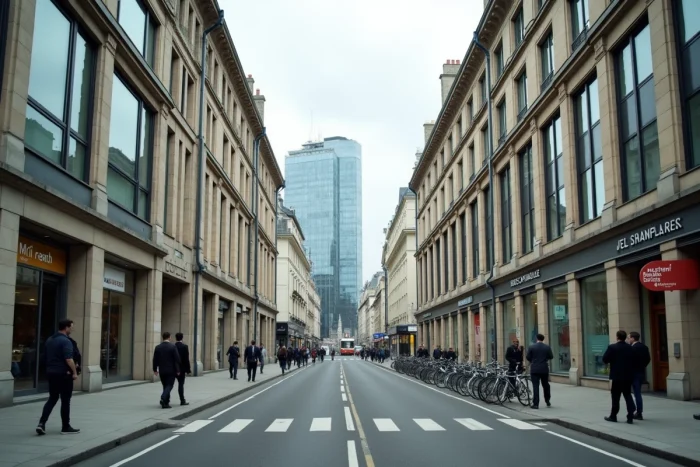
Headquarters and urban planning in Rennes: a little-studied relationship
The establishment of a headquarters is not just an economic issue. It concretely alters the urban landscape. The new building of L’Orange bleue, with its 3,700 m², fits into a visible trend in Rennes: the construction of tertiary premises designed to accommodate management functions.
The municipalities of the Rennes metropolis also capture some of these establishments. Companies choose peripheral business zones to benefit from larger spaces at lower costs while remaining within the urban area. The available data do not allow for precise quantification of this distribution between the city center and the periphery, but the trend is documented by local economic observatories.
This dynamic raises an urban planning issue: how does the metropolis articulate the densification of the center with the reception of new headquarters that require significant space? Available land in the city center is becoming scarce, which could push future establishments towards neighboring municipalities.
Economic attractiveness of Rennes: what headquarters say about the city
The lasting presence of headquarters in a city indicates its ability to provide a favorable environment for decision-makers: a skilled labor pool, accessibility (the high-speed train places Rennes less than two hours from Paris), and an attractive living environment for executives and their families.
However, Rennes suffers from a visibility deficit compared to metropolises like Lyon or Bordeaux when it comes to attracting headquarters of international companies. The players that settle or remain there are mostly French groups, often founded locally.
The 2025 ranking of companies where it is good to work in Brittany, published by the firm Happy To Meet You, highlights several Rennes-based companies recognized for their working conditions. Quality of life at work is becoming a territorial anchoring argument for companies that could theoretically establish themselves elsewhere.
Rennes will need to demonstrate its ability to attract new headquarters from other regions, beyond its capacity to retain locally founded groups. The demographic dynamism argues in its favor, but the professional real estate market is tightening and limiting land options for future establishments.