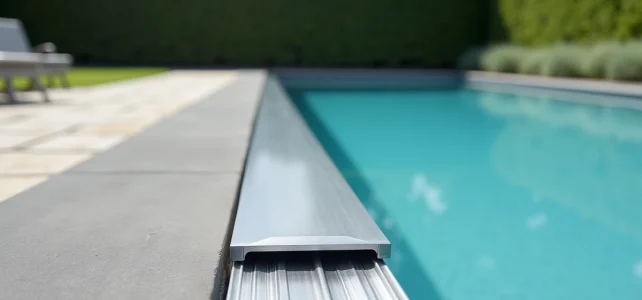
A telescopic pool cover that derails after three seasons, we’ve all heard this feedback from a neighbor or a close friend. The problem rarely comes from the cover itself, but from the ground guidance system. The guiding rail for the pool cover determines the smoothness of the sliding, durability over time, and compliance with safety standards. When well chosen and correctly installed, it transforms the daily use of the pool.
Powder-coated aluminum or stainless steel: which rail withstands coastal areas better
When installing a cover less than twenty kilometers from the coast, salt fog attacks metals within a few months. The choice of rail material is not cosmetic; it is the first structural decision.
Accelerated tests conducted by the CSTB in 2025 (updated DTU 60.11 study) document a superiority of powder-coated aluminum over stainless steel for resistance to salt corrosion. Stainless steel 304, often offered by default, develops corrosion pitting under the combined effect of chlorine and seawater. Powder-coated aluminum, thanks to its baked paint layer, forms a physical barrier that significantly delays oxidation.
In practice, it is observed that powder-coated aluminum rails maintain smooth sliding much longer in these aggressive environments. For a pool located in a continental area, feedback varies on this point, and stainless steel 316 remains a viable option. To learn more about possible configurations, consult the guiding rail for Abrisud pool covers to compare profiles suitable for each context.
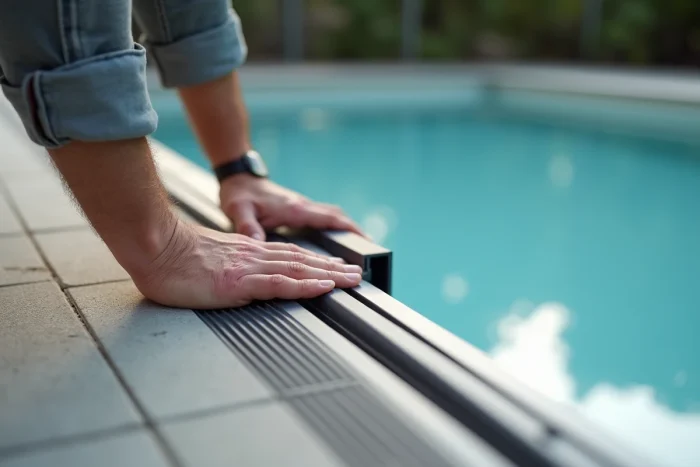
Recessed rails and NF P90-309 standard: what changes since 2025
Regulations have recently changed, and not all installers have integrated them. The decree of March 15, 2025, published in the Official Journal, modifies the NF P90-309 standard by imposing automatic obstacle detection during sliding. The latest generation rails now incorporate smart anti-collision sensors that stop the movement of the cover if an object or person is on the path.
This evolution primarily concerns new installations. For public pools, ordinance n°2024-1123 of November 6, 2024, makes the use of recessed rails mandatory to minimize the risk of falls around the pool. Individuals are not yet subject to this obligation, but the trend is clear: the recessed rail is becoming the expected standard.
Why the recessed rail offers better protection than an exposed rail
An exposed rail on the pool deck creates a raised surface on the ground. Even by a few millimeters, this elevation is enough to cause tripping, especially on wet coping stones. The recessed rail, on the other hand, is flush with the surface and eliminates this risk.
Recessing also offers a mechanical advantage: the rail is protected from direct impacts (falling objects, passage of garden furniture). Its lifespan is extended, and maintenance is limited to periodic cleaning of the groove to prevent debris accumulation.
Hybrid electric and solar motorization: reliability in rainy regions
Opening and closing a telescopic cover by hand is still possible, but on a large-span model, the physical effort discourages regular use. Motorization of the rail solves this problem, provided you choose a system suitable for the local climate.
According to a survey by the Federation of Pool Professionals (annual report 2025, published in April 2026), hybrid electric and solar motorized rails significantly reduce failures related to humidity in rainy regions. The solar panel provides the main power during sunny weather, while the electrical connection takes over during prolonged periods without sunlight.
This type of motorization also avoids overvoltage problems in case of storms, thanks to automatic decoupling. For a pool located in the northwest quarter of France or in mountainous areas, this hybrid configuration offers superior reliability compared to a purely solar system.
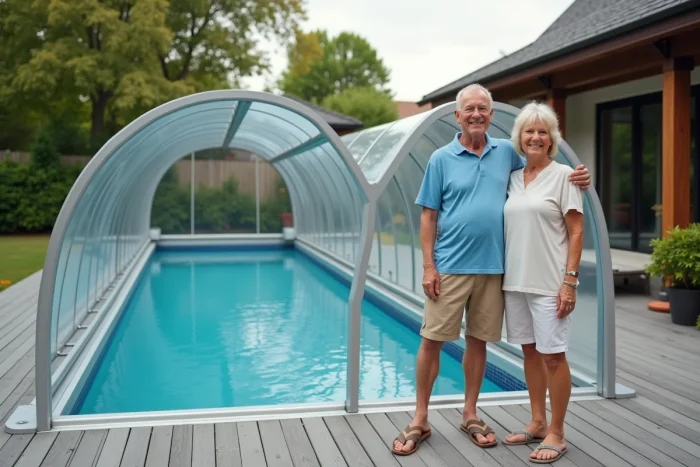
Maintenance of the pool guiding rail: actions that extend its lifespan
A well-installed but poorly maintained rail will eventually seize up. The smoothness of the sliding depends on the cleanliness of the groove and the condition of the bearings. A few simple actions, repeated at regular intervals, are enough to keep the system functional for many years.
- Clean the rail groove with low-pressure water at least once a month during the season to dislodge leaves, gravel, and limescale residues that block the rollers.
- Apply a silicone lubricant (never mineral grease, which attracts dust) to the sliding surfaces twice a year, ideally at the opening and closing of the season.
- Check the alignment of the telescopic modules after each episode of strong winds: a misaligned element by a few millimeters exerts lateral stress that prematurely wears out the pads.
- Inspect the ground fixings (anchors, plates) once a year, especially on composite wood decks where the material may shift with temperature variations.
On models equipped with anti-collision sensors, a monthly functionality test (placing an object on the rail and initiating closure) ensures that the safety device remains operational.
When to replace a guiding rail
Wear manifests as a metallic rubbing noise, increased effort in handling, or deep oxidation marks. If lubrication and cleaning do not restore smooth sliding, replacing the rail is necessary before the modules of the cover itself are damaged by mechanical stress.
A well-sized guiding rail, installed correctly and maintained regularly, ensures both safety around the pool and comfort of use on a daily basis. The choice of material according to the environment, compliance with the latest developments of the NF P90-309 standard, and simple but regular preventive maintenance make the difference between a pool cover that is truly used and equipment that ends up being left closed.