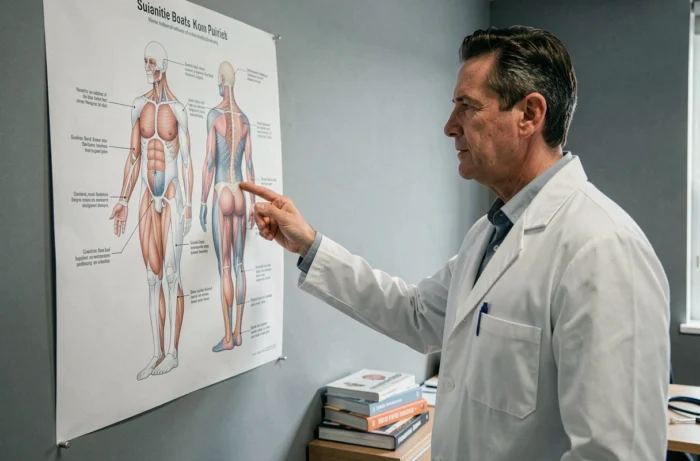
The letter Z closes the alphabet, and it also concludes most anatomical lists with a handful of terms. In human anatomy, the structures whose names start with Z can be counted on one hand. They encompass very different realities: a bone of the face, microscopic fibers of the eye, muscles engaged with every smile, or even an anomaly of the digestive wall.
Their rarity makes them an area of exploration where each term deserves to be detailed rather than simply listed.
Zygoma and zygomatic arch: a bone with multiple functions
The word zygoma is often translated as “cheekbone,” which gives the impression of a purely aesthetic structure. In reality, the zygoma refers to the malar bone of the face, a bony piece that contributes to the formation of the floor and lateral wall of the eye socket. Its outer face forms the prominence of the cheek, but its contribution does not stop there.
Depending on usage, the term can also refer to the zygomatic arch, a bony bridge formed by the junction of the malar bone with the zygomatic process of the temporal bone. This arch serves as an anchor point for the masseter muscle, one of the most powerful muscles of mastication. Without it, biting into hard food would be impossible.
A detailed inventory of the parts of the human body starting with z reveals that the zygomatic family alone includes several distinct entries: the zygomatic bone, the zygomatic arch, the zygomatic process, and the zygomaticofacial foramen, a small opening through which a sensory nerve of the cheek passes.

Zygomatic muscles: anatomy of the smile
The zygomaticus major and zygomaticus minor are two facial muscles. Their origin point is located on the zygomatic bone, and they insert at the corner of the lips and the upper lip.
The zygomaticus major pulls the lip corner upward and backward: it is the main muscle of the smile. The zygomaticus minor, more discreet, slightly lifts the upper lip and contributes to expressions of sadness or disgust, depending on the intensity of its contraction.
These two muscles are innervated by the facial nerve (VII). Paralysis of this nerve, as seen in Bell’s palsy, leads to a visible asymmetry of the smile because the zygomaticus major on the affected side no longer contracts. This anatomical detail explains why doctors ask the patient to smile during a neurological examination: the smile directly tests the functioning of the zygomatic muscles.
Zinn’s zonule: the fibers that hold the lens
The zonule of Zinn, or ciliary zonule, is not a compact organ. It is a network of microscopic fibers, the zonular fibers, that connect the lens to the ciliary body inside the eye.
These fibers play a role in the mechanism of visual accommodation. When the ciliary muscle contracts, the tension of the zonular fibers decreases and the lens rounds, allowing focus on nearby objects. When the muscle relaxes, the fibers tighten and the lens flattens for distance vision.
The degradation of these fibers with age contributes to presbyopia. In certain connective tissue pathologies, such as Marfan syndrome, the zonular fibers can be weakened, leading to a displacement of the lens called lens ectopia.
- The zonular fibers are primarily composed of fibrillin, a connective tissue protein
- Their partial rupture can cause lens subluxation, detectable during an ophthalmological examination
- The name “Zinn” refers to the anatomist Johann Gottfried Zinn, who described this structure in the 18th century, as well as the common tendinous ring of the orbit (Zinn’s ring)

Zenker’s diverticulum: an anatomical anomaly in Z
Zenker’s diverticulum is not a part of the body in the strict sense: it is an abnormal pouch that forms in the wall of the pharynx, at a site of muscular weakness known as Killian’s triangle. This hernia of the mucosa develops above the entrance of the esophagus.
Its presence can manifest as difficulty swallowing (dysphagia), regurgitation of undigested food several hours after a meal, or persistent bad breath. Zenker’s diverticulum primarily affects elderly individuals and its management is surgical or endoscopic depending on the size of the pouch.
This term illustrates a common trap in alphabetical lists of anatomy: they mix normal structures (bones, muscles, fibers) with anomalies or pathologies. Differentiating normal anatomical structure from acquired anomaly helps to better understand what one reads in these inventories.
Zona and terms in Z: confusions to avoid in the game of categories
Players of the game of categories or quizzes often look for a quick word starting with Z. The common reflex is to cite “zona,” but zona is an infectious disease (reactivation of the varicella-zoster virus), not a part of the body. The term “zona” in anatomy exists in another sense: it refers to functional regions of the adrenal gland (zona fasciculata, zona glomerulosa, zona reticularis), each producing different hormones.
- Zona glomerulosa: outer layer of the adrenal cortex, which produces aldosterone
- Zona fasciculata: middle layer, which secretes cortisol
- Zona reticularis: inner layer, involved in the production of adrenal androgens
For a word game, the safest term remains zygomatic, unambiguously recognized as a part of the body. The terms “zonule” or “zeugopod” (intermediate segment of a limb, between the shoulder and the hand or between the hip and the foot) are acceptable but less known to casual referees.
Anatomical structures starting with Z are rare, but each opens a door to a specific mechanism: mastication for the zygomatic arch, visual accommodation for Zinn’s zonule, facial expression for the zygomatic muscles. Their alphabetical rarity does not reflect their functional importance.