
A haircut that truly transforms a face does not rely on a trend spotted online. It is based on a precise reading of three parameters: the natural hair texture, the face shape, and the actual time available for styling each morning. Ignoring even one of these criteria is enough to achieve a disappointing result, even with a flattering model in a photo.
Hair Texture and Density: The Criterion That Morphology Alone Does Not Cover
Most haircut guides focus on the shape of the face. The problem is that the same bob can fall impeccably on thick, smooth hair, while it can completely collapse on fine, porous hair. The natural behavior of the hair influences the final result as much as the geometry of the face.
The bounce of curls, the density per square centimeter, and the fineness of the fiber determine how a cut will hold over time. Tightly curled hair visually shortens by several centimeters as it dries, which radically changes the perceived length. Very fine hair lacks hold as soon as it exceeds a certain length, unless a layering is added to artificially create volume.
Before choosing a style, three characteristics must be assessed: the thickness of the fiber (fine, medium, thick), the type of natural movement (smooth, wavy, curly, frizzy), and the overall density level. These data guide towards compatible haircut families and eliminate others. A pronounced layering suits dense hair that needs to be lightened, but it dangerously thins already sparse hair.
To deepen this hair diagnosis and discover beauty tips on Makeup Chic, the process benefits from being complemented by a precise visual analysis of the hair material.

Face Shape and Cut Lines: The Combinations That Work
The morphology of the face acts as a second filter, once the texture is identified. The goal is not to hide anything, but to rebalance the proportions between the forehead, cheekbones, and chin.
Identifying Your Morphology Without Complex Tools
Observing your reflection in a mirror, with hair pulled back, is sufficient in most cases. The width of the forehead compared to that of the jaw, the height of the face compared to its width, and the shape of the chin provide the necessary clues. The main categories are oval, round, square, rectangular, heart-shaped, and diamond-shaped faces.
Principles of Optical Balance
The mechanism is simple: a cut compensates for what the bone structure accentuates.
- A round face gains definition with volume on top and lengths that exceed the chin, which optically elongates the proportions.
- A square face softens with layered lines around the jaw and a soft movement at the temples, avoiding strict geometric cuts.
- A rectangular face appears less elongated with a fringe (curtain or tapered) that visually shortens the forehead, combined with lateral volume at the cheekbones.
- An oval face tolerates most haircut structures, which does not mean that all suit it: the hair texture remains the limiting factor.
The fringe is the most transformative element of a haircut because it directly alters the perception of the upper third of the face. A curtain fringe opens the gaze and lightens a wide forehead, while a straight fringe shortens an elongated face.
Daily Maintenance and Modularity of the Cut
A remarkable cut upon leaving the salon is worthless if it requires thirty minutes of styling each morning for a lifestyle that only allows five. The ease of maintenance determines the longevity of the result.
Modular cuts, which transition from a structured style to a more relaxed look depending on the time available, better meet real constraints. A textured bob can be worn sleek for an occasion and tousled for everyday wear. A well-calibrated layering falls naturally without blow-drying on wavy hair.
Three questions quickly filter viable options:
- How many minutes of styling are realistic each morning?
- Is a trip to the hairdresser for a shape maintenance feasible every four to six weeks, or rather every three months?
- What styling products are already used, and how willing are you to incorporate new ones?
A short pixie cut requires frequent maintenance to keep its structure, while a lob (long bob) is more forgiving of regrowth. This parameter often eliminates options that look appealing in photos but are incompatible with daily reality.
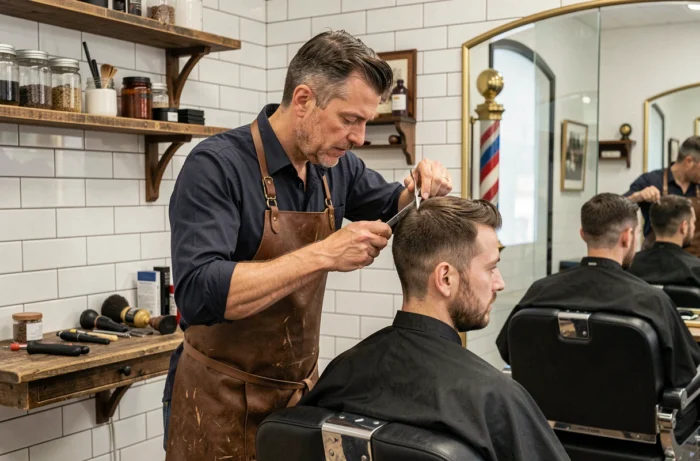
Simulation Tools and Professional Consultation: What Really Helps in Deciding
Some salons now integrate connected mirrors and simulation apps that allow clients to visualize a result before cutting. These tools project a model onto the client’s face, reducing the gap between expectation and reality.
The limitation of these technologies remains the texture. An algorithm can overlay a haircut shape onto a face, but it poorly simulates the fall of curly hair or the actual volume of fine hair. The manual assessment of the hairdresser (touch, observation of natural movement, elasticity test) provides information that no screen can capture.
The combination of both approaches yields the best results: simulation reassures and refines the visual choice, while professional diagnosis validates technical feasibility. Arriving at a consultation with reference photos speeds up the discussion, provided these photos show hair of a similar texture to one’s own.
Ultimately, the choice of a transformative haircut comes down to a clear arbitration between what is appealing, what physically suits, and what remains manageable in daily life. A successful cut is one that still works three weeks after leaving the salon, without disproportionate effort.