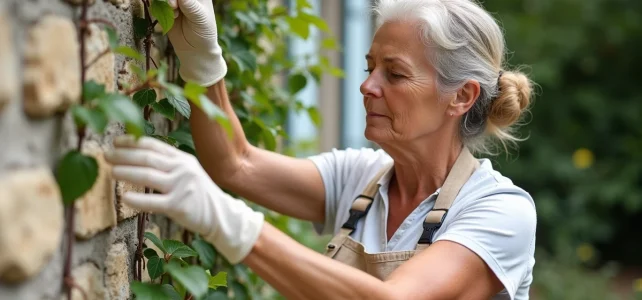
The star jasmine (Trachelospermum jasminoides) willingly grows against a wall, provided it has something to cling to. Its twining stems wrap around anything they find, but on a smooth surface, they slide and fall back down. Success depends on the choice of support and how the first shoots are guided.
Smooth wall and external insulation: what the support must respect
You may have noticed that some climbing plants can hold themselves on a stone wall, but not on a modern coating? The star jasmine does not produce suckers or hooks like ivy. It needs roughness or a trellis to wrap its stems around.
On a classic plastered wall, the most common solution remains a trellis fixed with dowels suitable for the material. Treated wood, galvanized metal, or rigid PVC: the support must withstand the weight of a plant that, in a few years, becomes dense and heavy.
The case of walls with external thermal insulation (ITE) deserves special attention. The guides from the Quality Construction Agency and the CSTB remind us that any fixing in an ITE must be planned or validated by the manufacturer of the system. Drilling a thin coating over insulation without caution can compromise the ten-year warranty. Some manufacturers even limit the height or density of vegetation allowed on their cladding.
For those who want to know how to make jasmine climb a wall without risking damage to the facade, self-adhesive trellis kits or glued rail systems (MS polymer adhesives, two-component epoxy) offer a recent alternative. These systems, which have emerged in recent years, avoid drilling while maintaining a solid support.
Fixing the trellis on an exterior wall: the right distance
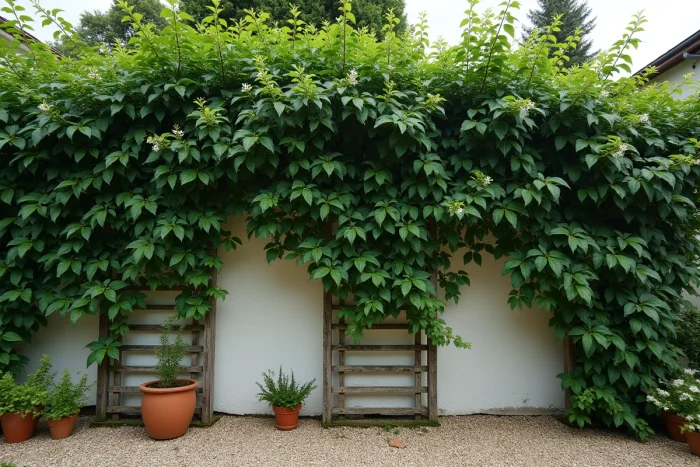
A trellis placed directly against the wall poses two problems. The stems of the star jasmine do not have enough space to wrap around. And air no longer circulates between the foliage and the wall, which promotes humidity.
Leave a gap of a few centimeters between the trellis and the wall. Shims or spacers (wooden battens, thick metal washers) are sufficient. This gap allows new shoots to pass behind the support and cling to it naturally.
Fixing points not to neglect
- Plan for fixings every 40 to 50 cm approximately, both in height and width, to prevent the trellis from deforming under the weight of the mature plant
- If the wall is made of plastered concrete blocks, use expansion dowels suitable for the hollow of the block, not simple lightweight plastic dowels
- On a stone wall, prefer fixings in the mortar joints rather than in the stone itself, to limit damage in case of removal of the support
The strength of the system should be tested before planting. Pull on the trellis at several points: if it moves, the mature jasmine will tear it down.
Guiding the stems of the star jasmine in the first two years
Once the support is in place, the plant does not climb by itself overnight. The young stems of Trachelospermum jasminoides are flexible but not autonomous. They seek support, and if they do not find it quickly, they crawl on the ground.
Attach the main stems to the trellis with soft ties (raffia, jute twine, rubber ties). Avoid bare wire that injures the bark as the stem thickens. The goal is to spread the growth in a fan shape, directing the branches towards the still empty areas of the support.
Why is this step so crucial? Because the star jasmine tends to concentrate its vegetation at the top of the wall if left to grow freely. Trimming the tall shoots and guiding the lateral ones results in a dense and even foliage across the entire surface.
Training pruning during growth
In the first year, let the plant settle without pruning. In the second year, after the summer flowering, shorten the stems that exceed the frame and those that stray from the wall. This light pruning stimulates branching and thickens the foliage cover.
Never prune at the end of winter on the branches that bear future flower buds. The flowering of the star jasmine is prepared on the wood of the previous year.
Exposure and watering of star jasmine against a wall
A wall facing south or southwest accumulates heat. The star jasmine appreciates this situation: it blooms longer and more abundantly in the sun. Observations in experimental gardens in France confirm that the plant grows faster on a warm wall over the last few decades, with a notable extension of the flowering period.
The downside of this exposure: the soil at the foot of the wall dries out quickly, especially in summer. The area directly against a facade receives very little natural rain.
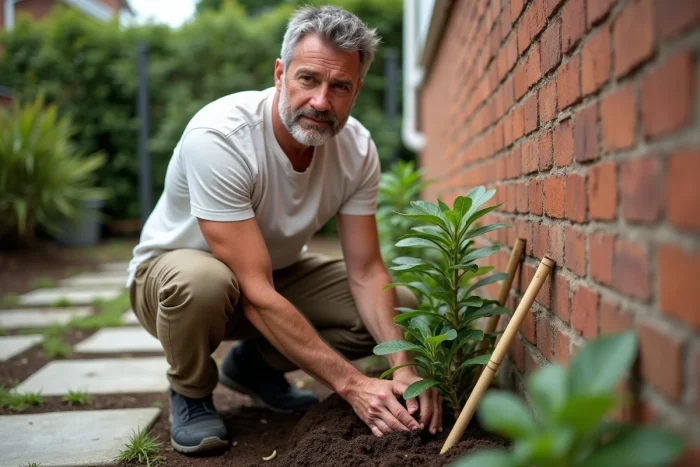
- Plant the star jasmine about thirty centimeters from the wall, never right at the base, so that the roots can access less dry soil
- Generously mulch the base with wood chips or dead leaves to maintain soil moisture
- Water regularly in the first and second years, then monitor for prolonged drought episodes in the following summers
The Trachelospermum jasminoides tolerates various soils, but it prefers well-drained, slightly acidic soil. Heavy, waterlogged soil in winter causes root rot, especially in pots or containers.
Ultimately, the climbing star jasmine on an exterior wall requires very little: a well-fixed support, careful initial guidance, and watering suited to the heat reflected by the facade. Once established, the evergreen foliage covers the wall all year round, and the fragrant white flowers return every summer without special intervention.