
Choosing a path after high school in creative professions means accepting a degree of uncertainty. 3D animation, video games, special effects: these fields excite high school students, but often worry their parents. The entertainment preparatory program addresses this dual tension by offering a structured, supervised, and professionalizing year that lays solid foundations before entering higher education.
Generative AI in entertainment prep: a program that anticipates the market
Generative AI tools are transforming visual creation professions. Assisted modeling, texture generation, rapid prototyping of concepts: these technologies are already present in animation studios and video game companies. Ignoring this reality in a preparatory curriculum would mean training students for a market that no longer exists.
Several entertainment preparatory programs now integrate modules dedicated to these tools. The goal is not to replace drawing or sculpture with a prompt, but to learn to use AI as a creative accelerator. A student who masters both artistic fundamentals and AI-assisted workflows enters higher education with a head start.
For parents, this integration has a concrete effect: it proves that the training keeps pace with sector developments. A program that teaches charcoal perspective in the morning and AI prototyping in the afternoon shows that it prepares for real jobs, not a fixed vision of creative professions.
Choosing an entertainment prep to reassure students and parents makes perfect sense when the curriculum reflects the tools that recruiters expect.
Qualiopi certification and transparency: what reassures families concretely
Since January 2026, Qualiopi certification is mandatory for all entertainment preparatory programs. This is not a marketing label. It is a regulatory requirement that mandates each institution to publish verifiable indicators: employment rate, continuation of studies rate, satisfaction rate.

Why does this change matter so much to parents? Because it eliminates opacity. Before this requirement, comparing two preparatory programs was akin to comparing marketing brochures. With Qualiopi, families gain access to standardized and audited data.
This regulatory framework also impacts the quality of education itself. To obtain and maintain certification, schools must document their processes, train their instructors, and adapt their programs. A virtuous circle that directly benefits students.
Here are the points that parents can verify thanks to this certification:
- The continuation of studies rate after the preparatory program, indicating whether the year actually leads to admission in higher education
- The student satisfaction rate, collected anonymously and published annually
- The qualifications of instructors, who must demonstrate professional experience in the entertainment sector
- The existence of documented individualized follow-up, not just announced in a brochure
Dropout rate in entertainment prep: motivation through concrete projects
Entertainment preparatory programs show a dropout rate approximately 20% lower than that of general artistic preparatory programs. This figure, derived from a Campus France study on success rates in creative fields published in January 2026, deserves attention.
The main reason lies in project-based pedagogy. From the first weeks, students work on concrete achievements: an animated short film, a character concept for a video game, a complete storyboard. Producing something tangible from the first month maintains motivation.
In general artistic prep, the first months are often devoted to academic exercises disconnected from a visible outcome. Observation drawing, color theory, art history: all of this is useful, but without quick application, some students lose interest.
The entertainment prep does not eliminate these fundamentals. It integrates them into projects that give immediate meaning to each learning experience. Learning perspective means building a set. Studying color means creating an atmosphere for an animation scene.
Individualized support: reducing post-high school anxiety for students and parents
A qualitative survey by AEESIP published in March 2026 highlights a often underestimated point: parents of students in entertainment prep report a notable reduction in post-high school anxiety thanks to individualized support. The contrast with traditional scientific preparatory programs, known for their pressure, is clear.
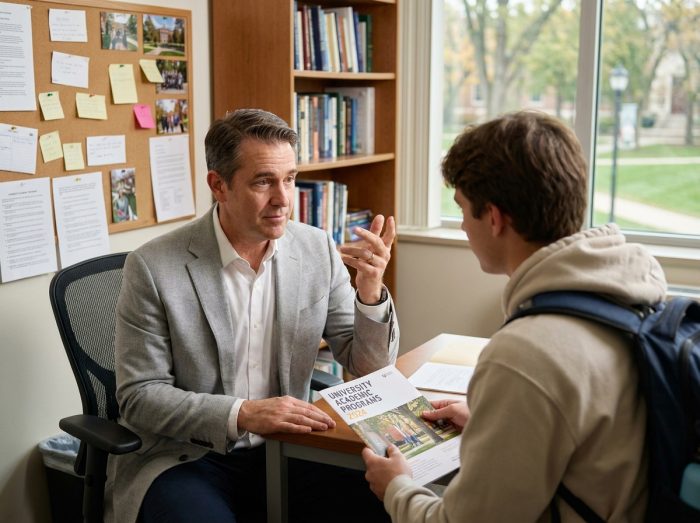
This support takes several forms. A pedagogical referent follows each student throughout the year. Classes remain small. Assessments are continuous, not high-stakes exams.
For the student, this means a right to make mistakes. Failing a project is not disqualifying; it is a learning step analyzed with the supervisor. For parents, this means having a designated contact in case of doubts or difficulties.
- A unique referent for each student, reachable by families throughout the year
- Quarterly reports shared with parents, detailing progress and areas for improvement
- An active orientation towards higher education, with assistance in preparing application files
This system transforms the preparatory year into a supported transition rather than a leap into the unknown. The student builds their professional project step by step. Parents see the progress, understand the opportunities, and realize that their child is evolving in a structured environment.
The entertainment prep does not eliminate all uncertainties related to creative professions. The paths remain demanding, and selection for higher schools remains competitive. What it provides is a verifiable skill base, a regulated framework since 2026, and a pedagogy that gives students concrete reasons to continue, week after week.