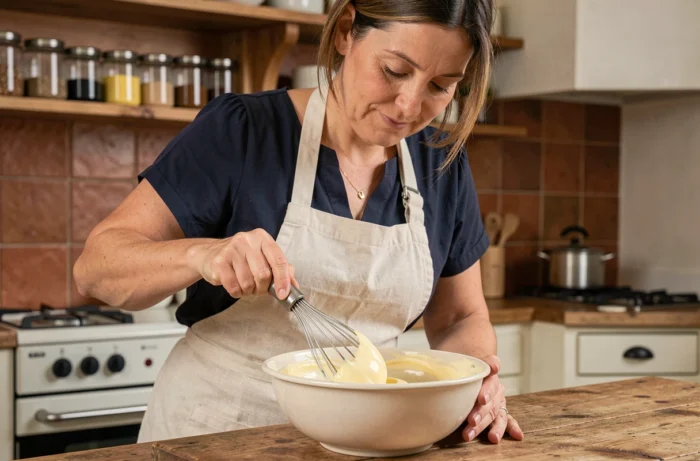
Homemade mayonnaise relies on a simple physical process: dispersing oil droplets in an aqueous phase (egg yolk, mustard, vinegar) to form a stable emulsion. The whisk creates this dispersion, and its shape directly affects the size of the droplets—and therefore the final texture.
Buying guides often compare whisk shapes in general terms, but mayonnaise presents a specific challenge: you’re working with a small volume in a narrow container, using quick, steady strokes. It’s worth considering your whisk choice from this perspective.
Mayonnaise for one: the challenge of a small volume in a narrow container
Most kitchen whisks are designed for large mixing bowls and medium to large quantities. Making mayonnaise for one person with a single egg yolk and a few tablespoons of oil changes the equation.
In a narrow bowl or measuring jug, a classic balloon whisk catches on the sides. Its outer wires don’t work the mixture; they slide along the sides of the container. The egg yolk stays at the bottom, the oil collects on the surface, and the emulsion never forms.
A sauce whisk (also called a French whisk), which is narrower and longer, reaches the bottom of the container and shears the mixture where it is concentrated. Its tapered shape allows for an effective circular motion, even in a narrow space. It’s the best type of whisk for making a single serving without an electric appliance.
So before you choose a whisk for homemade mayonnaise, consider the container as well as the recipe: a whisk that works well in a 24 cm mixing bowl may be useless in a 10 cm bowl.
Sauce whisk or balloon whisk for mayonnaise: practical selection criteria
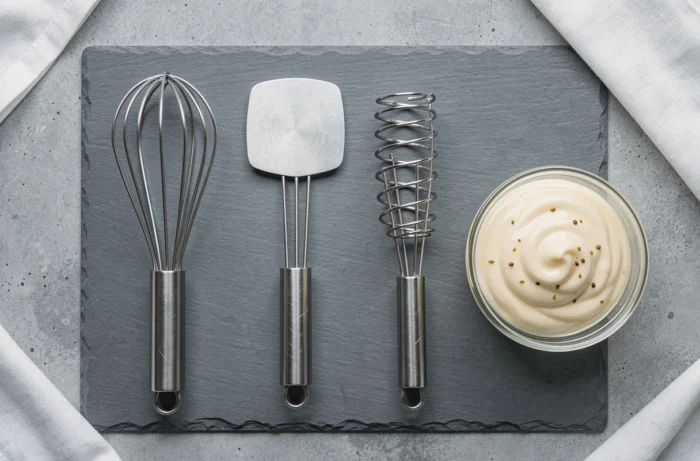
A balloon whisk incorporates air thanks to its many rounded wires. That’s an advantage when whipping egg whites or cream, but mayonnaise doesn’t need air to be incorporated. The goal is the opposite: to create a dense, smooth emulsion without bubbles.
A sauce whisk, with fewer, stiffer wires, exerts greater shearing force on the mixture. This mechanical pressure breaks the oil droplets into smaller particles, resulting in a thicker, more stable texture.
What to check before buying
- The length of the wires relative to the depth of your usual container. If the wires don’t reach the bottom of the bowl, the whisk won’t work the area where the emulsion starts to form.
- The number of wires: for mayonnaise, a narrow whisk with fewer wires (six to eight) creates more friction than a balloon whisk with twelve or more.
- Wire stiffness: flexible wires absorb the energy of your strokes instead of transferring it to the mixture. Rigid stainless steel remains the go-to material for emulsions.
- Handle diameter: a handle that’s too thin will tire your hand quickly, which matters because mayonnaise requires vigorous whisking for several minutes.
Silicone and nylon protect nonstick coatings, but they offer less mechanical resistance. For mayonnaise made in a glass or stainless steel bowl, an all-stainless-steel whisk is still the most effective choice.
How quickly to add the oil: what the whisk can’t make up for
A good whisk makes emulsifying easier, but it can’t fix a mistake in technique. At first, add the oil drop by drop, giving the first droplets time to disperse into the egg yolk. Only once the mixture has thickened should you pour in a steady stream.
Adding the oil too quickly will cause the mayonnaise to split, regardless of the whisk you use. Faster wrist movements can’t compensate for pouring in too much oil at once. This point is often overlooked in utensil comparisons, which can give the impression that the right equipment alone guarantees success.
Ingredient temperature and a successful emulsion
Eggs straight from the refrigerator make it harder to get the emulsion started. Cold yolk is more viscous, which slows the initial dispersion of the oil. Letting the ingredients come to room temperature for about 20 minutes before you start makes a noticeable difference.
Mustard, often added to the yolk, acts as a natural surfactant: it stabilizes the interface between the oil and water. An egg yolk at room temperature combined with a spoonful of mustard creates a more receptive base than a cold yolk on its own, even with a perfectly suited whisk.
How to fix split mayonnaise without changing whisks
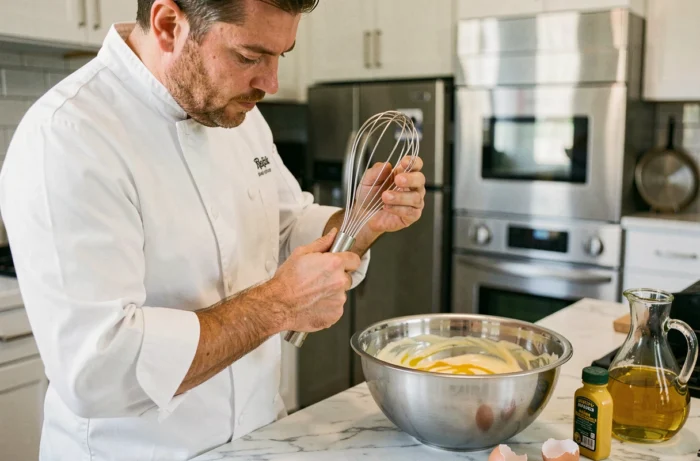
Mayonnaise that has separated isn’t necessarily a lost cause. The classic method is to start with a fresh egg yolk in a clean bowl, then gradually whisk in the failed mayonnaise, one spoonful at a time, just as you would add oil.
A sauce whisk is once again more practical than a balloon whisk for this task. The starting volume is very small (just one yolk), and the container needs to be narrow enough for the whisk to reach the mixture. Starting again in a small bowl with a sauce whisk is the most reliable way to save a failed emulsion.
Another option is to add a few drops of warm water to the split mayonnaise and whisk vigorously. The water changes the ratio of the aqueous phase and may restart the emulsion, but the result is less predictable than starting again with a fresh yolk.
Food safety and storage: a limitation the whisk can’t solve
Homemade mayonnaise contains raw egg. No whisk or preparation technique changes that. It should be eaten promptly and stored in the refrigerator. This food-safety consideration has nothing to do with your choice of utensil, but it’s worth remembering because it determines how much to make.
Making a single serving instead of a large bowl reduces waste and food-safety risks. That’s another reason to choose a narrow sauce whisk designed for small quantities rather than a balloon whisk intended for larger volumes.
Choosing a whisk for homemade mayonnaise comes down to geometry: the tool’s shape should match the amount you’re making and the diameter of the container. For a single serving without an electric appliance, a narrow, rigid stainless steel sauce whisk is still the best fit. The rest—adding the oil patiently and bringing the ingredients to room temperature—is down to technique, not equipment.