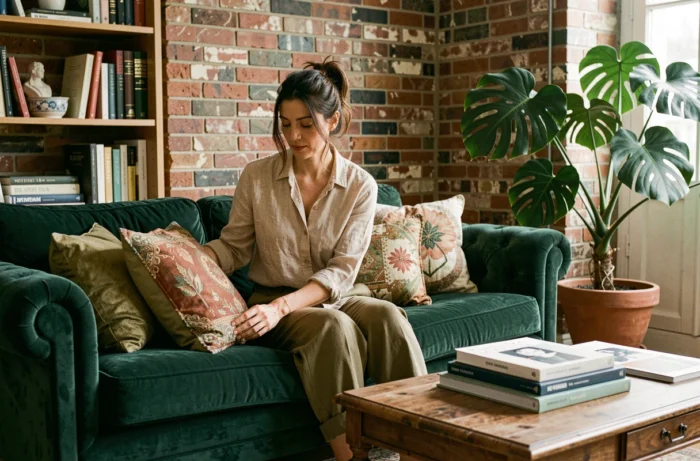
Redecorating an interior does not start with a purchase. It begins with a fresh look at what already exists: the light in a room, the proportions of the walls, the materials present. The decor trends of 2026 confirm this shift. They guide towards a few targeted actions to transform the atmosphere of a living room or bedroom without tearing everything apart.
Enveloping color: the real lever for redecorating an interior in 2026
French interiors are increasingly similar: white walls, light wood, touches of gray. According to IFOP, a large majority of French people desire more color in their living environment, which is perceived as increasingly uniform.
The answer does not come from a simple colorful cushion. The trends observed in autumn 2026 describe a more enveloping application of color. Walls, woodwork, furniture, and even bathrooms are treated in bold shades. The mentioned palettes include polar blue, orange-red, midnight blue, wasabi, and pastel yellow.
Painting a wall and its woodwork in the same bold shade eliminates visual breaks. The room gains depth. This is the opposite of an isolated accent wall, which creates a poster effect.
To explore decor on Just in Déco, you will find color and material combinations that illustrate this immersive approach well.
Upholstery textiles: PFAS regulation changes the game in 2026
Changing textiles remains the most accessible redecoration gesture. Curtains, sofa covers, throws, cushions: they alter the perception of a room in just a few hours. But in 2026, a new criterion is added to the selection.
Law No. 2025-188 of February 27, 2025, regulates PFAS, these chemical substances used in stain-resistant and waterproof treatments for many upholstery fabrics. This changes the game for anyone buying new textiles.
Why care about this during a redecoration? Because textiles treated with PFAS are found in common products: tablecloths, covers, blackout curtains. Checking the composition and treatments applied becomes a useful reflex, not only ecological but also regulatory.
Concrete criteria for choosing decor textiles
- Prefer fabrics certified as free from PFAS treatments by checking the label or the manufacturer’s product sheet
- Opt for natural fibers (linen, cotton, wool) that age better and develop a patina over time
- Vary textures within the same room: a thick knit throw next to a light linen curtain creates contrast without overwhelming
Reuse and recovery: redecorating with second-hand furniture
Reuse is no longer a niche DIY project. In Île-de-France, structured channels for reusing construction materials are developing. This movement also affects interior decoration and furniture.
A vintage or reclaimed piece of furniture brings a uniqueness that cannot be replicated with new items. A sanded and waxed farmhouse table, a school chair repainted in a bold wasabi, a golden mirror found at a flea market: these pieces tell a story. They break the uniformity that the French criticize.
The practical advantage is twofold. The budget remains controlled, and the style achieved is unique. No one else will have exactly the same Art Deco dresser in their living room.

Before thrift shopping: prepare your redecoration
Diving into a flea market without a plan leads to accumulation. Before searching, identify the role of each piece you want to add. A storage unit, an accent light, an additional seat. Each object must serve a specific function in the room, not just be pretty.
Also measure the available space. An imposing sideboard in a modestly sized living room produces the opposite effect of what is desired. The right find is one that matches the actual dimensions of your interior.
Light and arrangement: transforming a room without buying anything
Moving a sofa a few dozen centimeters changes the flow in a living room. Orienting a seat facing the window rather than the wall alters the perceived brightness. These adjustments are free and often underestimated.
Artificial light plays a role comparable to the color of the walls. A pendant light that is too high or a single ceiling fixture flattens the ambiance. Multiplying light sources (reading lamp, low-voltage string lights, table lamp on a low piece of furniture) creates distinct zones within the same room.
- Test several positions for the sofa and table before finalizing a layout: live with each configuration for a few days
- Place light fixtures at varying heights to create visual relief, not just to illuminate
- Use a mirror facing a source of natural light to diffuse brightness into dark areas
The 2026 trend towards maximalism, documented at the Maison & Objet show, encourages some to accumulate objects and colors. Accumulation works in large spaces. In a standard apartment, it’s better to have three well-thought-out changes than a dozen haphazard additions. A dyed wool throw, a repositioned light fixture, an enveloping color on a wall: these three actions are often enough to give a distinctive style to an interior that lacked it.